

Last Updated: November 15, 2026
Quick Summary
To check fabric color accuracy, compare a physical fabric swatch against your approved standard under a D65 daylight source in a dim, neutral space, then recheck under warm indoor light to catch metamerism. Record any deviation and, if possible, log the Delta E before cutting.
- Set up a D65 daylight bulb away from direct sun and colored walls.
- Order 1 to 2 meters for verification before committing to bulk production.
- Check swatches under D65, then warm indoor light, to catch metamerism.
- Judge color by physical swatch, never by an uncalibrated screen image.
- Run a wash test and crock test to confirm color fastness separately.
Table of Contents
- Why Fabric Color Accuracy Decides Whether a Garment Sells
- The Best Lighting for Fabric Color Assessment
- Textile Color Matching Tools From Swatch to Spectrophotometer
- Understanding Metamerism in Textiles
- Step-by-Step: Testing a Fabric Swatch Against Your Standard
- Wash Test and Crock Test: Checking Color Fastness, Not Just Color
- Common Causes of Fabric Color Mismatch and How to Troubleshoot Them
- Ordering Swatches and Samples From Simplifi Fabric
- Frequently Asked Questions
Why Fabric Color Accuracy Decides Whether a Garment Sells
Fabric color accuracy is the practice of confirming that a dyed or printed textile matches an approved standard under controlled conditions, before any cutting begins. It decides whether a garment sells because color is the first thing a shopper sees and the fastest reason to walk away.
At Simplifi Fabric, swatch requests often start with the same worry: the color online looked different in person. That worry is reasonable. A 2016 study from Hong Kong Polytechnic University's fabric texture research(https://ira.lib.polyu.edu.hk/handle/10397/86623) found that texture itself shifts measured color, with blue textures producing the largest color difference and grey and yellow the smallest.
Cut before you check, and a whole run is wasted. Check first, and you keep the fabric, the money, and the customer.
The Best Lighting for Fabric Color Assessment
The best lighting for fabric color assessment is a D65 daylight source in a neutral viewing space. D65 approximates average daylight and is the reference most of the textile industry uses for color matching.
Why does it matter? Because color is light. Change the bulb and the fabric changes with it.
Traditional visual assessment depends on trained inspectors working under D65 standard lighting, and even then it is prone to human error compared with digital colorimetry, according to EXTERNAL_LINK: Linshang Technology's guide to textile color assessment | linshang.com.
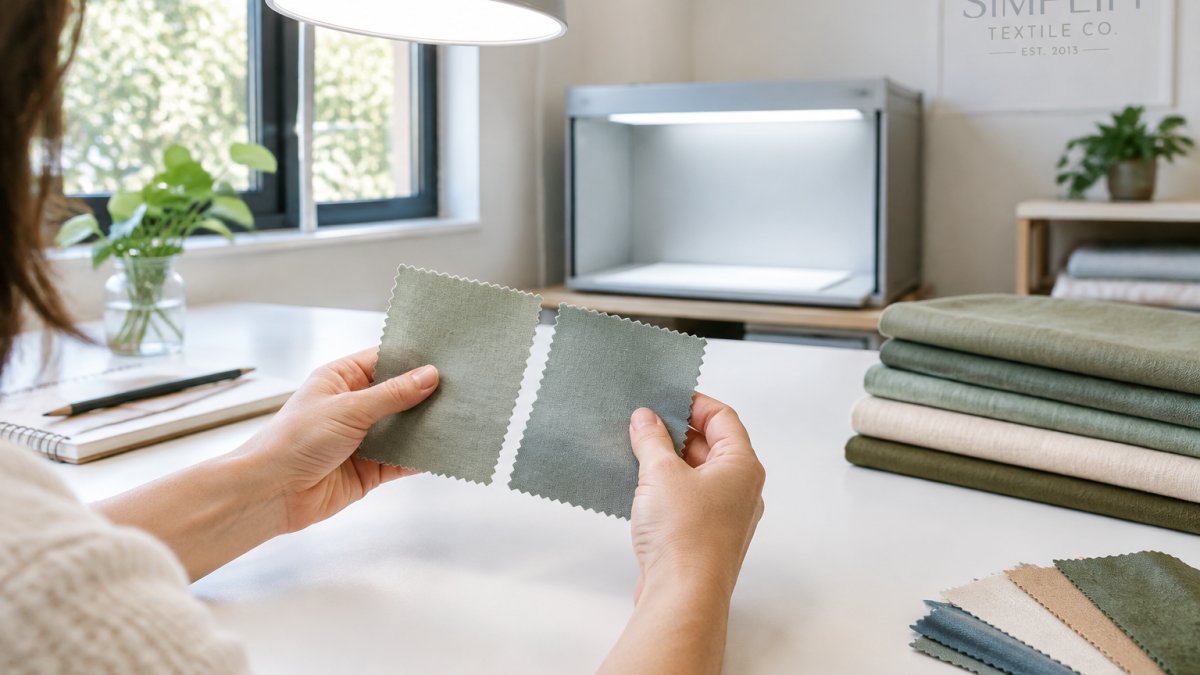
Setting Up a D65 Viewing Station at Home
A home setup does not need a lab. It needs consistency.
- Place the viewing spot away from direct sun and colored walls
- Use a D65 daylight bulb or a small light booth
- Cover the table with matte white or neutral grey paper
- Keep the room dim so stray light does not skew the match
- Hold swatches flat, side by side, at the same angle
- View at arm's length, not inches from your nose
Textile Color Matching Tools From Swatch to Spectrophotometer
Textile color matching tools range from a free fabric swatch to a spectrophotometer that reads color as numbers. Home sewists can often start with the first option; production teams typically need the last.
Here is how the options compare.
| Tool | What It Does | Best For |
|---|---|---|
| Fabric swatch | Physical sample to hold against your standard | Home sewists, first checks |
| Light booth | Provides consistent D65 lighting | Anyone doing visual assessment |
| Colorimeter | Reads color in about 30 seconds | Small studios, quick checks |
| Spectrophotometer | Measures full color data across wavelengths | Production and bulk runs |
A portable colorimeter can complete a color quality check in roughly 30 seconds, EXTERNAL_LINK: Linshang Technology reports | linshang.com. That speed is why small studios adopt them.
Reading Delta E and Color Tolerance Numbers
Delta E is the measured distance between your sample and your standard. A lower number means a closer match. Color tolerance is the limit you set for acceptable difference.
Set your tolerance before you measure. Otherwise every reading becomes an argument.
Understanding Metamerism in Textiles
Metamerism in textiles is when two fabrics match under one light source but clash under another. A pair that looks identical in the shop can look obviously different in daylight.
This is why a single light source is never enough. Check your swatch under D65, then again under warmer indoor light. If the match breaks down, the dyes are metameric and the fabric is risky for a garment that will be worn in mixed lighting.
Step-by-Step: Testing a Fabric Swatch Against Your Standard
Testing a fabric swatch against your standard takes about ten minutes and a few basic items. Work through it in order, and note that you do not need a colorimeter to get a reliable first read, a physical standard and consistent light will catch most problems.
- Order a short run of 1 to 2 meters for verification, the sample size recommended by EXTERNAL_LINK: Muze Fab's custom printing guidance | muzefab.com before bulk production
- Let the fabric rest flat for a few hours so folds do not distort the surface
- Set up your viewing station, a D65 bulb in a dim room is enough; a full light booth is better but not mandatory
- Place the swatch beside your approved standard on neutral paper, never on a colored cutting mat
- Assess color under D65, then again under warm indoor light to catch metamerism
- Record any color deviation in writing, including which light source revealed it
- If you have a colorimeter, measure and log the Delta E; if not, use a physical standard chip as your reference
- Repeat the check on a second piece from the same batch to catch lot variation
Low-Cost Verification Without a Colorimeter
A physical standard, a retained swatch from the approved lot, or a lab dip, held beside the new fabric under consistent light is a practical way to verify color without specialized equipment.
Keep the standard physical, not digital, because display calibration drifts and ambient light changes what you see on a screen.
Watch out: comparing a new swatch to a screen image instead of a physical standard is the most common DIY error, the screen will always look more saturated than the cloth.
Once the color passes, move on to construction. Tips for sewing with organic cotton cover how the fabric behaves under the needle.
Wash Test and Crock Test: Checking Color Fastness, Not Just Color
Color fastness is how well a fabric holds its color through washing and rubbing. It is a separate question from color accuracy, and both matter.
A wash test launders a sample the way the finished garment will be washed, then compares it to the unwashed piece. A crock test rubs the fabric against white cloth, dry and wet, to see how much dye transfers.
Watch out: testing a wash sample at the wrong temperature tells you nothing useful. Match the wash to real care instructions, which the sustainable linen care guide sets out in detail.
Common Causes of Fabric Color Mismatch and How to Troubleshoot Them
Color mismatch usually comes from one of a few sources. Match the cause to the fix, and pay attention to the fiber, different substrates absorb dye and ink at different rates, which is the variable most troubleshooting guides skip.
| Problem | Likely Cause | Fix |
|---|---|---|
| Batch looks darker | Dye lot variation | Request a new swatch from the current lot |
| Match fails in daylight | Metamerism | Test under D65 before cutting |
| Print looks uneven | Substrate texture | Compare on the same base cloth |
| Color shifts after washing | Poor color fastness | Run a wash test first |
| Screen color looks off | Uncalibrated display | Judge by physical swatch, not the screen |
| Print looks lighter than proof | Fiber porosity | Adjust ink load for the substrate |
Why Fiber Type Changes the Result
Polyester and cotton do not take color the same way. Polyester and cotton can take color differently, so a print that matches on one fiber may shift on another even with an identical file and ink set.
The practical fix is to always compare like with like: verify a polyester print against a polyester standard, not against a cotton swatch from a previous run. When you switch base cloth, treat it as a new color approval rather than assuming the old standard carries over.
Watch out: approving a color on one fiber and printing it on another without a fresh swatch check is the most common cause of a batch that passes inspection but fails in the garment.
Digital tools help but do not solve everything. A 2025 Nature Scientific Reports study(https://www.nature.com/srep) found that imaging and preprocessing frameworks can improve color reliability in textile images, yet physical checks remain the final word.
If a mismatch makes you doubt the fabric's origin, how to verify fabric organic certifications walks through the paperwork.
Ordering Swatches and Samples From Simplifi Fabric
Simplifi Fabric ships worldwide from Ontario and has curated eco-friendly textiles since 2012. Ordering a physical swatch is a simple way to check color accuracy before you commit to yardage.
Start with a small sample, test it against your standard, and then decide on the full amount. Sustainable fabric sourcing for beginners explains the whole process from first order to final cut.
Ethical sourcing and reliable color go together. Ethical fabric sourcing for small businesses shows how makers protect both.
Color mistakes cost fabric, time, and customer trust. Simplifi Fabric helps makers avoid them with a curated range of organic and sustainable textiles, indie sewing patterns, and notions for every skill level. Order a swatch first, test it under proper light, and cut with confidence. Get started with Simplifi Fabric and check your color before the scissors come out.
Frequently Asked Questions
Why does fabric color look different in person than online?
Screens emit light while fabric reflects it, so the same hex code renders differently on a monitor than on cloth. Fabric texture matters too: research has found that fabric texture can shift measured color. Photos are also shot under studio lighting that rarely matches your room. Order a physical swatch before committing to yardage, and judge it under D65 light rather than your phone screen.
How can I ensure color consistency when ordering fabric online?
Ask for a swatch from the current dye lot, then compare it to any fabric you already own from the same line. Keep a physical reference card for every fabric you sew with, labelled with the supplier and order date. When you reorder, check the new swatch against that card under the same lighting. Batch consistency varies between dye runs, so a 1 to 2 metre sample run is the standard way to verify color before bulk production, as is common practice in custom printing.
What is a colorimeter and do I need one for sewing?
A colorimeter measures reflected light and returns a numeric color value, removing some of the guesswork from visual assessment. Portable units can complete a check quickly. Most home sewers do not need one: a D65 light source and a physical swatch cover the majority of decisions. A colorimeter earns its place if you sell garments, match dye lots across batches, or need repeatable data to hand to a supplier.
What is metamerism in textiles and how do I avoid it?
Metamerism is when two fabrics appear to match under one light source but diverge under another, usually because they use different dye chemistry or substrate. Check every pair under at least two sources, such as D65 daylight and a warm indoor bulb, before you cut. If the pair shifts apart, treat them as a mismatch even if they looked identical in the shop. Understanding metamerism in textiles saves you from garments that only match in the room where you sewed them.
